We've seen this movie before. A transformative technology emerges. Employees adopt it faster than IT can govern it. Leadership oscillates between enthusiasm and fear. Sound familiar? It's the cloud adoption curve, circa 2010 — and it's playing out again with AI in 2026. The good news: we already know the playbook.
The Cloud Adoption Curve (A History Lesson)
Before we talk about AI governance, let's remember what happened with cloud computing. The pattern followed four distinct phases, and understanding them is critical to navigating AI adoption:
Phase 1: Denial (2008-2011)
"The cloud is a fad. Our data center is more secure. No serious enterprise would put production workloads on someone else's servers." IT departments actively resisted cloud adoption while developers quietly spun up AWS instances with corporate credit cards. Shadow IT was born.
Phase 2: Reluctant Acceptance (2011-2014)
The shadow cloud footprint became too large to ignore. CIOs acknowledged cloud was happening but tried to contain it — approved vendor lists, cloud governance committees, extensive approval processes that slowed adoption to a crawl while shadow usage continued to grow.
Phase 3: Strategic Adoption (2014-2018)
Leading organizations realized that governance isn't about saying no — it's about saying yes, safely. Cloud Centers of Excellence emerged. Landing zones, guardrails, and self-service portals gave developers the speed they wanted with the controls IT needed. Shadow cloud usage declined as the sanctioned path became easier than the unsanctioned one.
Phase 4: Infrastructure (2018-Present)
Cloud became invisible infrastructure. Nobody debates whether to use it; the question is how to optimize it. FinOps, multi-cloud strategy, and cloud-native architectures are mature disciplines. The governance frameworks built in Phase 3 evolved into industry standards.
The AI Adoption Curve (Where We Are Now)
Map those same four phases to AI, and the parallels are striking:
Phase 1: Denial (2022-2023)
"ChatGPT is a toy. It hallucinates. No enterprise would use AI for real work." Meanwhile, employees across every department — legal, marketing, engineering, finance — began using AI tools to draft documents, analyze data, write code, and summarize meetings. Shadow AI was born.
Phase 2: Reluctant Acceptance (2023-2025)
Organizations discovered that 40-60% of employees were already using AI tools, often with sensitive company data. Knee-jerk reactions followed: Samsung banned ChatGPT after a source code leak. Banks blocked AI tools entirely. Other companies issued vague "use AI responsibly" memos with no enforcement mechanism.
Phase 3: Strategic Adoption (2025-2027) — We Are Here
This is where we are right now. The organizations that will win the next decade are building AI governance frameworks that enable adoption while managing risk. The ones that get it right will attract the best talent (who refuse to work without AI tools) and outperform competitors in productivity.
Phase 4: Infrastructure (2027+)
AI will become invisible infrastructure — embedded in every tool, every workflow, every decision. The governance frameworks built in Phase 3 will determine which organizations thrive and which ones spend the next decade cleaning up ungoverned AI debt.
The Wrong Approach: Ban Everything
Let's address the temptation directly. Banning AI tools entirely is the 2026 equivalent of banning cloud computing in 2010. It fails for the same reasons:
- Employees route around bans. Personal devices, personal accounts, browser-based tools that leave no IT footprint. The AI usage doesn't stop; it just becomes invisible and ungovernable.
- Productivity loss is real and measurable.Studies consistently show 25-40% productivity gains from AI tools in knowledge work. Banning AI is a competitive disadvantage your rivals won't share.
- Talent attrition accelerates. Developers and knowledge workers increasingly choose employers based on tool availability. A ban signals technological conservatism that repels top talent.
- You lose the ability to govern what you ban.Sanctioned usage creates logging, monitoring, and policy enforcement opportunities. Banned usage is invisible usage.
The Right Approach: The Five-Step Governance Framework
Effective AI governance follows the same discover-classify-govern pattern that worked for cloud. Here's the framework:
Step 1: Discover
You can't govern what you can't see. The first step is building a complete inventory of AI usage across your organization:
- Network analysis: Monitor DNS queries and network traffic for connections to known AI service endpoints (OpenAI, Anthropic, Google AI, Hugging Face, etc.)
- API key audit: Search code repositories, environment variables, and secret stores for AI service API keys
- Expense report scanning: Identify AI service subscriptions in corporate expense reports and procurement systems
- Browser extension audit: Catalog AI-powered browser extensions installed on corporate devices
- Code analysis: Scan codebases for AI SDK imports, model loading patterns, and inference calls
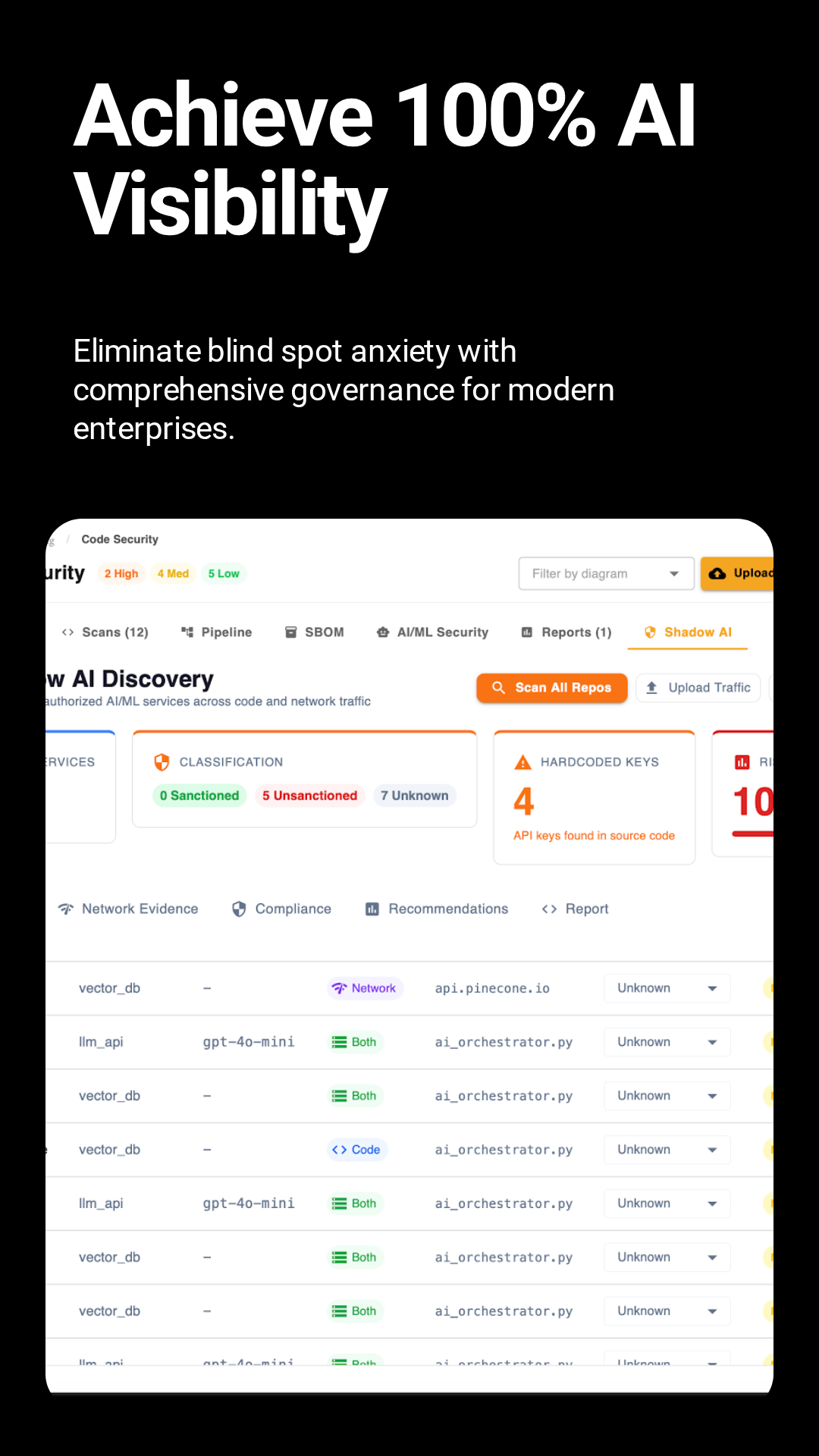
Ayurak's Shadow AI Discovery automates this across all five vectors simultaneously, producing a comprehensive AI usage inventory within hours rather than weeks.
Step 2: Classify
Once discovered, every AI usage instance gets classified into one of three categories:
- Sanctioned: Approved AI tools with defined use cases, data handling policies, and monitoring in place. Employees are encouraged to use these for approved purposes.
- Under Review: AI tools that have been identified but not yet assessed. Usage is temporarily permitted under monitoring while the security and privacy review completes.
- Unsanctioned: AI tools that have been assessed and rejected due to security, privacy, or compliance concerns. Usage is blocked with clear communication about approved alternatives.
The key principle: always provide an alternative. When you classify a tool as unsanctioned, point to the sanctioned alternative that serves the same need. If no alternative exists, that's a signal to fast-track evaluation of one.
Step 3: Set Policy
For each sanctioned AI tool, define policies covering:
- Data classification: What data sensitivity levels can be processed? (Public, internal, confidential, restricted)
- Use cases: Approved use cases with examples. "You may use Copilot for code generation. You may not use it to process customer PII."
- Output handling: How should AI-generated content be reviewed, attributed, and stored?
- Incident reporting: What to do if sensitive data is accidentally processed through an AI tool
Step 4: Enforce
Policies without enforcement are suggestions. Enforcement mechanisms include:
- Network-level controls: Block or redirect traffic to unsanctioned AI services
- DLP integration: Data Loss Prevention tools configured to detect and block sensitive data being sent to AI endpoints
- API gateway proxying: Route all AI API calls through a corporate proxy that enforces data classification policies, logs usage, and can redact sensitive content
- Automated monitoring: Continuous scanning for new unsanctioned AI usage, with alerts to governance teams
Step 5: Enable
The final and most important step: make the sanctioned path the easiest path. This is the lesson from cloud governance that too many organizations forget.
- Self-service provisioning: Let teams request and receive access to sanctioned AI tools without a 6-week procurement cycle
- Pre-built integrations: Provide sanctioned AI tools already integrated into existing workflows — IDE plugins, Slack bots, API wrappers
- Training and examples: Show employees how to get the most value from sanctioned tools. The better the sanctioned experience, the less temptation to go rogue.
- Feedback loops: Let employees request new tools and use cases. Fast evaluation timelines signal that governance is an enabler, not a blocker.
The EU AI Act Factor
The EU AI Act adds a regulatory dimension to AI governance that makes a structured framework non-optional for any organization operating in or serving the European market. The Act classifies AI systems into four risk categories:
- Unacceptable Risk: Banned outright. Social scoring systems, real-time biometric identification in public spaces (with narrow exceptions), manipulative AI targeting vulnerable populations. If any of your AI usage falls here, it must stop immediately.
- High Risk: Permitted with strict requirements. AI in critical infrastructure, education, employment, law enforcement, and immigration. Requires risk management systems, data governance, technical documentation, human oversight, accuracy monitoring, and cybersecurity measures.
- Limited Risk: Transparency obligations only. Chatbots must disclose they're AI. Deepfakes must be labeled. Emotion recognition systems must inform subjects.
- Minimal Risk: No specific requirements. Spam filters, AI-powered video games, inventory management systems. Most business AI falls here but must still be documented.
Ayurak automatically classifies your discovered AI usage against EU AI Act risk categories, identifies high-risk systems that need additional controls, and generates the technical documentation required for compliance. This classification integrates directly into the five-step governance framework — Step 2 (Classify) now includes regulatory risk classification alongside internal security classification.
Lessons from the Cloud, Applied to AI
Five key lessons from a decade of cloud governance that directly apply to AI:
- Governance is an enabler, not a blocker. The moment governance is perceived as "the department of no," people route around it. Frame governance as the fastest path to safe AI adoption.
- Shadow usage is a signal, not a crime. When employees use unsanctioned tools, they're telling you that the sanctioned options don't meet their needs. Listen to that signal.
- Start with visibility, not control. You can't govern what you can't see. Discovery must precede policy. Attempting to set policies without understanding current usage produces policies that are immediately irrelevant.
- Automation beats process every time. Manual governance processes don't scale. Automated discovery, classification, and enforcement scale to thousands of employees and hundreds of AI tools without proportional headcount.
- The window for strategic governance is narrow. Organizations that built cloud governance frameworks in 2014 had a smooth transition. Those that waited until 2018 spent years cleaning up ungoverned cloud sprawl. The AI governance window is now — 2025-2027. After that, the cleanup cost multiplies.
"We spent 18 months cleaning up shadow cloud in 2016. When AI hit, we deployed governance in the first quarter. The five-step framework we built for cloud worked almost identically for AI — we just needed different discovery tools." — VP of Engineering, Fortune 500 Retailer
Building Your AI Governance Program
The path forward is clear: apply the cloud governance playbook to AI with modern tooling. Discover what's happening. Classify it. Set intelligent policies. Enforce them technically. And above all, enable the safe adoption that makes governance feel like a service rather than a tax.
The organizations that get this right won't just be compliant — they'll be faster, more innovative, and more secure than competitors who are still debating whether to ban ChatGPT.
Start Your AI Governance Journey
Discover shadow AI usage, classify risk levels, and build enforceable governance policies — with EU AI Act compliance mapping built in. The five-step framework, automated.
Start Your AI Governance Journey