We get this question weekly: "How does Ayurak compare to Snyk?" or "Are you replacing SonarQube?" The honest answer is: we're not competing with either of them. We operate at a fundamentally different layer of the security stack — and the organizations that understand this distinction build the strongest security postures.
What Snyk Does Well
Snyk has earned its position as a leader in developer-first security. Their strengths are real and substantial:
- Dependency scanning (SCA): Snyk's vulnerability database for open-source packages is among the best in the industry. It catches known CVEs in your dependency tree, including transitive dependencies, with actionable fix recommendations.
- Container security: Snyk Container scans Docker images for OS-level vulnerabilities and provides base image upgrade paths. For teams shipping containers, this is essential.
- Developer experience: IDE integrations, PR checks, and CLI tools that meet developers where they work. The friction to adopt Snyk is remarkably low.
- Infrastructure as Code scanning: Snyk IaC catches misconfigurations in Terraform, CloudFormation, and Kubernetes manifests — checking individual resource configurations against security best practices.
If you're not using Snyk or a comparable SCA tool, you should be. Dependency vulnerabilities account for a significant portion of real-world breaches, and Snyk makes finding them trivial.
What SonarQube Does Well
SonarQube (and SonarCloud) is the gold standard for static analysis and code quality:
- SAST (Static Application Security Testing):SonarQube analyzes source code for security vulnerabilities — injection flaws, XSS, insecure deserialization, hardcoded credentials — across 30+ programming languages.
- Code quality gates: Beyond security, SonarQube enforces code quality standards — complexity, duplication, test coverage thresholds — preventing technical debt accumulation.
- Deep language analysis: SonarQube's analyzers understand code semantics, tracking data flow through functions and across files to find vulnerabilities that pattern-matching tools miss.
- CI/CD integration: Quality gates that block merges when security or quality thresholds aren't met. This prevents regression at the pull request level.
SonarQube catches bugs that would otherwise reach production. For any team writing code, it's a foundational tool.
The Layer Nobody's Covering
Here's the gap: both Snyk and SonarQube operate at the code level. They analyze source files, dependencies, container images, and individual resource configurations. They answer the question: "Is this code secure?"
But there's a higher-order question they can't answer: "Is this architecture secure?"
An architecture where every individual component passes Snyk and SonarQube scans can still be fundamentally insecure. A perfectly coded API with no vulnerabilities, connected to a perfectly configured database, can still create a lateral movement opportunity if the network segmentation between them is wrong. No code scanner sees that.
This is the layer Ayurak operates at — the architecture layer. We analyze how components interact, where trust boundaries exist (or don't), how data flows across the system, and how an adversary would traverse the topology.
The Honest Comparison
Here's a detailed capability matrix showing where each tool operates. This isn't marketing spin — it's an honest assessment of what each platform does and doesn't do:
| Capability | Snyk | SonarQube | Ayurak (Aribot) |
|---|---|---|---|
| Threat Modeling | ❌ Not available | ❌ Not available | ✅ STRIDE + PASTA + MITRE ATT&CK |
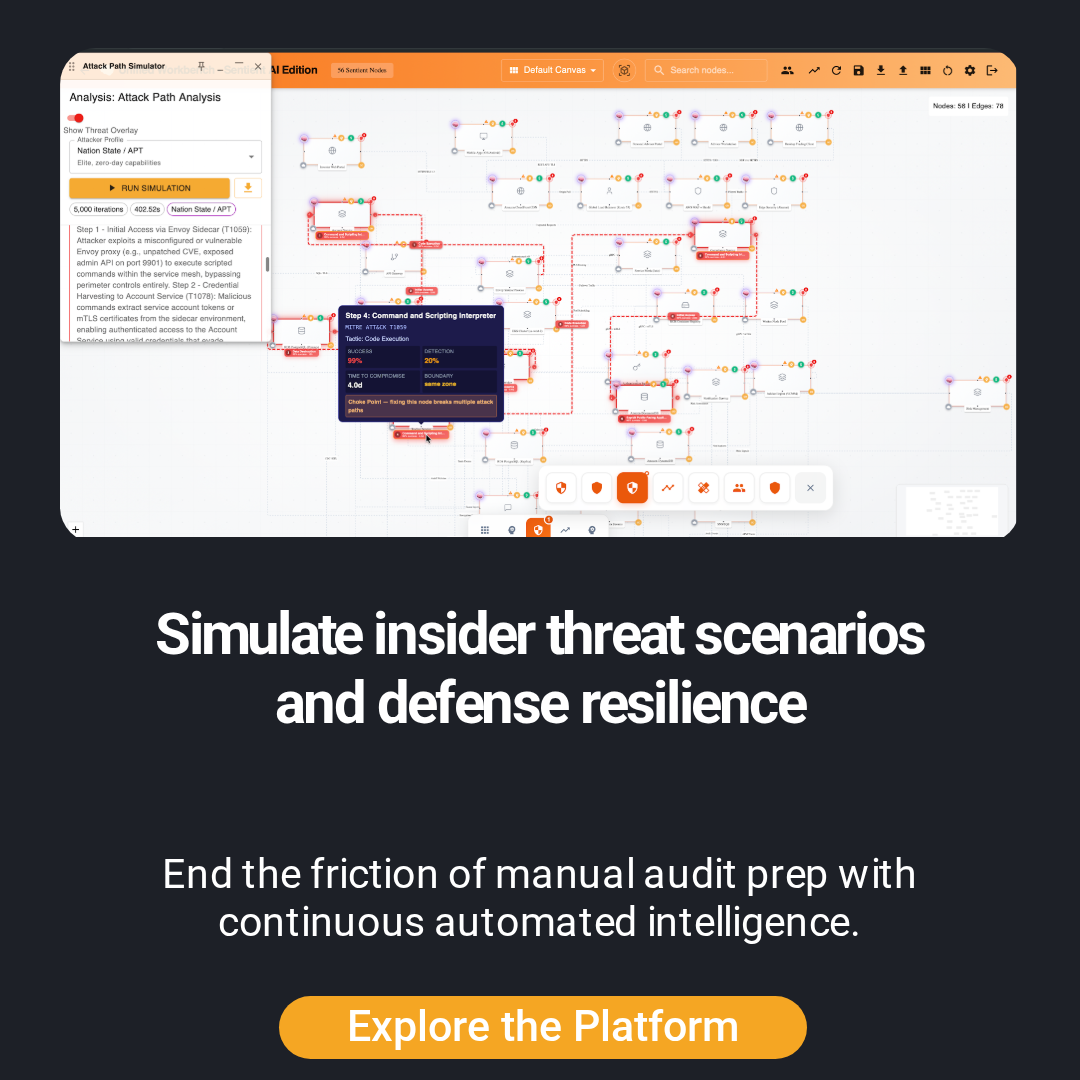
| Attack Path Simulation | ❌ Not available | ❌ Not available | ✅ Monte Carlo, 5,000 iterations |
| Code Review / SAST | ⚠️ Snyk Code (limited languages) | ✅ Best-in-class, 30+ languages | ⚠️ Architecture-aware review |
| Dependency / SCA Scanning | ✅ Industry-leading database | ⚠️ Basic dependency checks | ❌ Not our focus |
| Container Security | ✅ Snyk Container | ❌ Not available | ⚠️ Container topology analysis |
| AI/ML Security | ❌ Not available | ❌ Not available | ✅ Prompt injection, model security, agent guardrails |
| Shadow AI Discovery | ❌ Not available | ❌ Not available | ✅ Network + API + code analysis |
| Compliance Mapping | ⚠️ Basic reporting | ⚠️ Quality standards only | ✅ ISO 27001, SOC 2, PCI DSS, NIST, EU AI Act |
| Architecture Diagrams | ❌ Not available | ❌ Not available | ✅ Auto-generated from IaC, NLP, or upload |
Notice the pattern: where Snyk and SonarQube are strong, Ayurak is weak or absent. Where Ayurak is strong, they don't operate at all. This isn't accidental — it's by design.
When to Use Snyk + SonarQube
Use Snyk and SonarQube when you need to answer code-level questions:
- Does this pull request introduce a known CVE through a new dependency?
- Does this function have an SQL injection vulnerability?
- Is this Docker base image up to date with security patches?
- Does this code meet our complexity and duplication thresholds?
These are essential questions. Every engineering team should have answers to them. Snyk and SonarQube provide those answers better than almost anyone.
When to Use Ayurak
Use Ayurak when you need to answer architecture-level questions:
- Can an attacker reach our database from an external API in fewer than three hops?
- Which components create the highest systemic risk if compromised?
- Does our architecture meet ISO 27001 Annex A control requirements?
- Are employees using unsanctioned AI services that process customer data?
- What's the probability that a nation-state actor could exfiltrate our ML training data?
These questions require understanding the relationships between components, not just the components themselves. That's architecture-level security.
Can They Work Together?
Absolutely — and they should. The strongest security posture combines all three layers:
- Architecture layer (Ayurak): Ensures the overall system design is secure before code is written. Identifies attack paths, choke points, and compliance gaps at the design level.
- Code layer (SonarQube): Ensures the implementation is secure as code is written. Catches bugs, vulnerabilities, and quality issues in source code.
- Dependency layer (Snyk): Ensures the supply chain is secure throughout the lifecycle. Monitors open-source dependencies, containers, and IaC configurations.
Ayurak can ingest findings from Snyk and SonarQube to enrich its architecture-level analysis. A component with known CVEs in its dependencies gets a higher compromise probability in attack path simulations. A service with SAST findings gets flagged as a potential weak link in the architecture graph.
The Real Comparison
If Ayurak isn't competing with Snyk and SonarQube, what is it competing with? The honest answer: ad-hoc tooling and manual processes.
Before Ayurak, architecture-level security meant:
- Manual threat modeling sessions with sticky notes and whiteboards
- Spreadsheets mapping controls to compliance frameworks
- Quarterly pen tests as the only architecture-level validation
- No systematic way to assess AI/ML-specific risks
- Shadow AI discovery through periodic manual audits
Ayurak replaces these manual, inconsistent processes with automated, continuous architecture security. That's the real competitive displacement.
The Integration Story
Ayurak integrates with your existing security toolchain rather than replacing it. Findings from Snyk and SonarQube flow into Ayurak's architecture model. Ayurak's compliance mappings reference code-level evidence from your SAST and SCA tools. The result is a unified security posture that spans from architecture decisions to individual lines of code.
This integration means your security team gets a single dashboard showing risk at every level — not three separate tools with three separate views that someone has to mentally combine.
Making the Decision
If you're building a security program from scratch or prioritizing investments, here's a practical staging approach:
- Stage 1 — Ayurak: Start with architecture-level security. Threat model your system design, run attack path simulations, and establish compliance baselines. This prevents the most expensive category of security flaws — architectural ones.
- Stage 2 — SonarQube: Add code-level analysis as your codebase grows. Quality gates on pull requests prevent implementation bugs from reaching production. This is most valuable when you have active development teams writing new code daily.
- Stage 3 — Snyk: Add supply chain security as your dependency tree grows. This is especially critical for teams using many open-source packages, shipping containers, or managing infrastructure as code.
Each stage adds a security layer without conflicting with the others. The total cost of all three is a fraction of a single production security incident.
See the Full Aribot Platform
Explore how Ayurak's architecture-level security complements your existing Snyk and SonarQube investments. Threat modeling, attack simulation, compliance mapping, and AI security — the layer your code scanners can't see.
See the Full Aribot Platform