Your cloud bill includes the cost of hosting every unpatched endpoint, every over-permissioned service account, and every unencrypted data flow. You're not just failing to secure your infrastructure — you're paying for the privilege of being vulnerable. Let's do the math.
The Compound Cost of Insecure Design
Security flaws don't just create risk — they create cost at every stage of the software lifecycle. The later a flaw is discovered, the more expensive it becomes. This isn't opinion; it's well-documented across decades of software engineering research:
Design Time: ~$500 per flaw
An architect changes a diagram. A trust boundary is added. A network segmentation rule is documented. The fix is a design decision that costs nothing more than the time to discuss and document it. No code is rewritten, no deployments are rolled back, no customers are notified.
Development Time: ~$5,000 per flaw
A developer refactors code, updates tests, and goes through code review. The fix touches multiple files, requires regression testing, and delays the sprint by a day or two. The cost is real but contained to the development team.
Deployment Time: ~$50,000 per flaw
The flaw is discovered during staging or in production before exploitation. A hotfix is developed under pressure. QA runs emergency regression. The release train is disrupted. Change advisory boards convene. Rollback plans are activated. Multiple teams are pulled off their planned work.
Incident Time: ~$500,000+ per flaw
The flaw is exploited. Incident response teams mobilize. Forensic investigation begins. Legal counsel is engaged. Customer notification obligations are assessed. Regulatory reporting deadlines loom. PR teams manage media. And the remediation still needs to happen — now under the worst possible conditions.
That's the 100x multiplier: from $500 at design time to $500,000+ at incident time. Every flaw you don't catch in the diagram costs 100x or more to fix in production.
The Daily Bleed You Don't See
Beyond the dramatic incident costs, insecure architecture creates a continuous operational drain that rarely appears as a line item in anyone's budget:
Compute Spend on Attack Surface
Every over-provisioned service, every unnecessary public endpoint, every redundant component that exists "because we might need it" isn't just a security risk — it's compute spend. An exposed API that nobody uses still consumes load balancer capacity, firewall rule processing, logging storage, and monitoring overhead.
We've seen organizations reduce their cloud bill by 15-25% simply by decommissioning components that were identified as unnecessary attack surface during threat modeling. They weren't optimizing for cost — they were optimizing for security. The cost savings were a side effect.
Engineering Firefighting
Insecure architecture creates a steady stream of security alerts, false positives, and "urgent" patches that consume engineering time. Teams that spend 20-30% of their sprint capacity on reactive security work accept it as normal. It's not normal — it's the tax you pay for not securing the architecture upfront.
A well-architected system with clear trust boundaries, proper segmentation, and minimal attack surface generates fewer alerts, fewer patches, and fewer fire drills. The engineering time saved is directly reinvested in product development.
Slower Velocity
Insecure architecture creates invisible drag on development velocity. Every new feature must navigate around security workarounds. Every deployment requires extra validation because the blast radius of a failure is unclear. Every code review includes manual security checks that should be automated. The team moves at 70% capacity and doesn't realize the remaining 30% is consumed by architectural security debt.
Compliance Overhead
Architecture-level security gaps create the most expensive compliance findings. An auditor who discovers missing network segmentation doesn't just write a finding — they question the entire control environment. Remediation isn't a code fix; it's an infrastructure redesign under audit pressure with a deadline.
AI Infrastructure Makes Everything Worse
If the 100x multiplier is bad for traditional infrastructure, it's catastrophic for AI infrastructure. The economics of AI security failures are an order of magnitude worse:
GPU Costs Are Not Compute Costs
Traditional compute runs at $0.02-0.10 per vCPU-hour. GPU instances for AI workloads run at $3-30 per GPU-hour — a 100x premium. Every insecure AI component costs 100x more to host than its traditional equivalent. An unprotected ML inference endpoint that gets abused doesn't just create a security incident; it creates a five-figure cloud bill overnight.
Unprotected Inference Endpoints
A publicly accessible model inference endpoint without rate limiting, authentication, or input validation is an invitation for abuse. Cryptocurrency miners, prompt injection researchers, and competitors can all consume your GPU resources. We've seen organizations discover $50,000+ in unauthorized inference charges because an ML endpoint was exposed without proper controls.
Model Theft
A trained model represents months of compute time, proprietary training data, and intellectual property. Model extraction attacks — where an adversary queries a model systematically to reconstruct it — are well-documented. If your model is accessible without adequate controls, you're not just hosting an attack surface; you're hosting a competitor's R&D department.
Training Data Exposure
Training data often contains the most sensitive information in the organization — customer data, proprietary business intelligence, medical records, financial transactions. An insecure training pipeline that exposes this data doesn't just create a breach; it creates a regulatory catastrophe. GDPR fines, HIPAA violations, and PCI DSS non-compliance stack on top of each other.
Shadow AI: The Cost You Don't Know About
Perhaps the most insidious cost of insecure architecture is the one you can't measure: shadow AI. Employees using unsanctioned AI tools with company data create costs that don't appear in any dashboard:
- Data leakage to training sets: Information entered into consumer AI tools may be used for model training. Your competitive intelligence, customer data, and proprietary processes become training data for tools your competitors also use.
- Compliance violations: Every unsanctioned AI interaction with regulated data (PII, PHI, financial records) is a potential compliance violation that you can't detect, investigate, or report.
- Decision quality: AI-generated outputs that haven't been validated by appropriate models or reviewed under governance policies create silent quality degradation in business decisions.
Organizations typically underestimate shadow AI usage by 3-5x. When Ayurak's Shadow AI Discovery runs for the first time, the most common reaction is: "We had no idea it was this widespread."
The Case for Design-Time Security, With Numbers
Let's make this concrete with a real scenario. Consider a mid-size MedTech company — let's call them "MedTech Corp" — that runs Ayurak's threat modeling and attack path simulation on their new patient data platform before development begins.
The simulation identifies three critical findings:
- Finding 1: Missing encryption on internal data flows between the patient intake API and the records database. Design-time fix: add TLS requirement to the architecture spec. Cost: $200 (30 minutes of architect time). If discovered as a HIPAA breach: $150,000+ (incident response, OCR notification, potential fines).
- Finding 2: Over-permissioned service account for the ML pipeline with read/write access to the production patient database. Design-time fix: define least-privilege IAM roles in the architecture document. Cost: $200. If exploited as a data exfiltration vector: $200,000+ (forensics, legal, patient notification, regulatory penalties).
- Finding 3: No network segmentation between the public-facing appointment booking system and the internal records infrastructure. Design-time fix: add a trust boundary and define segmentation rules. Cost: $200. If exploited for lateral movement: $90,000+ (incident response, infrastructure redesign under pressure, business interruption).
Total design-time cost: $600. Total potential incident cost: $440,000+. That's a 733x multiplier — even worse than the industry average because healthcare regulatory penalties stack on top of standard incident costs.
The Ayurak Approach: Fix It in the Diagram
Ayurak's design-time security philosophy is built on a simple principle: the cheapest bug to fix is the one you catch before writing code. Our platform enables this through:
- Architecture-level threat modeling: Upload a diagram, import IaC, or describe your system — get a comprehensive threat model in minutes, not weeks
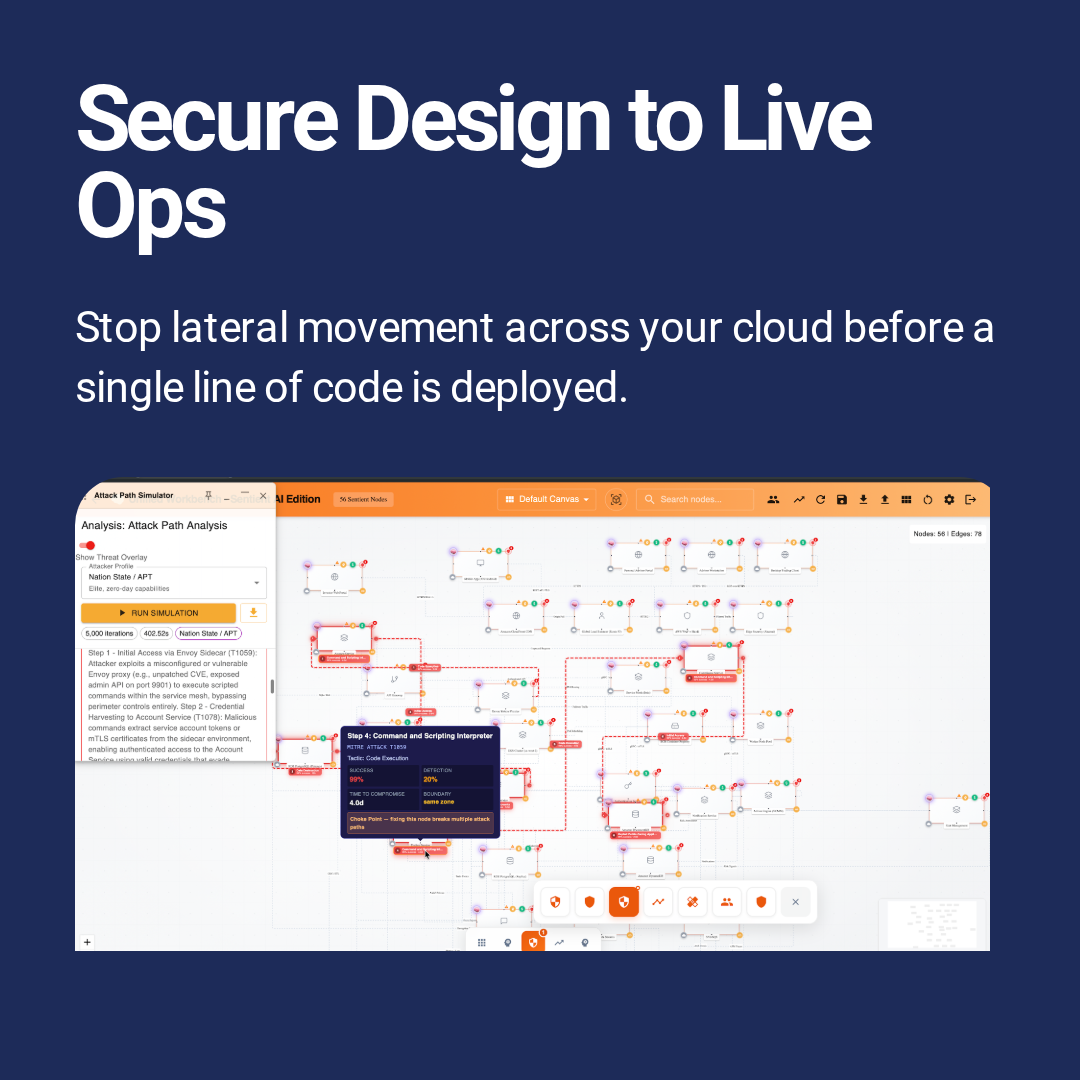
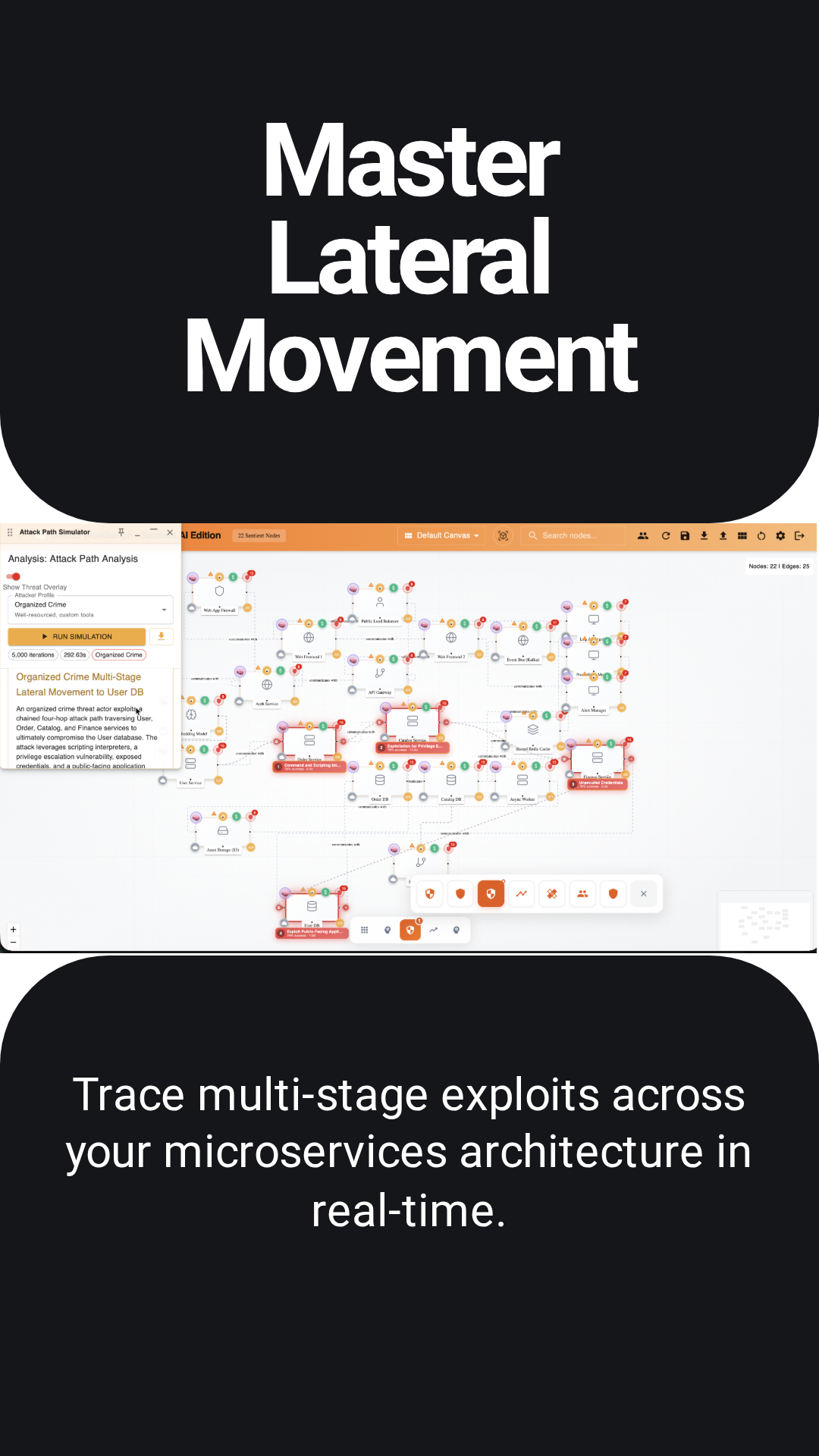
- Attack path simulation: Monte Carlo simulation with 5,000 iterations reveals which paths attackers would actually take, prioritized by probability and impact
- Compliance mapping: Every finding automatically maps to ISO 27001, SOC 2, PCI DSS, NIST CSF, and EU AI Act controls — compliance as a byproduct
- AI-specific security: Shadow AI discovery, prompt injection testing, agent guardrails, and model security assessment — because AI infrastructure deserves AI-aware security
Stop Paying to Host Your Attack Surface
Every month you operate insecure architecture, you're paying three bills: the cloud bill for hosting it, the engineering bill for working around it, and the risk bill for the incident that hasn't happened yet.
The first two bills are real and measurable today. The third bill is probabilistic but potentially catastrophic. Design-time security reduces all three simultaneously — less attack surface means less infrastructure, less firefighting, and less risk.
"After running Ayurak's simulation, we decommissioned 23 components that were unnecessary attack surface. Our cloud bill dropped 18%, our security alerts dropped 40%, and our deployment velocity increased because the blast radius of changes was clearer." — Platform Engineering Lead, Series B FinTech
The question isn't whether you can afford design-time security. The question is whether you can afford not to have it — because you're already paying for the consequences.
See Design-Time Security in Action
Upload your architecture diagram and discover the hidden costs before they compound. Attack path simulation, compliance mapping, and AI security assessment — all before you write a line of code.
See Design-Time Security in Action