In 2015, the average enterprise had 1,083 cloud services running — and IT knew about 108 of them. We called it Shadow IT. We spent a decade building CASBs and SaaS management platforms to tame it. Now the same thing is happening with AI, and the stakes are exponentially higher.
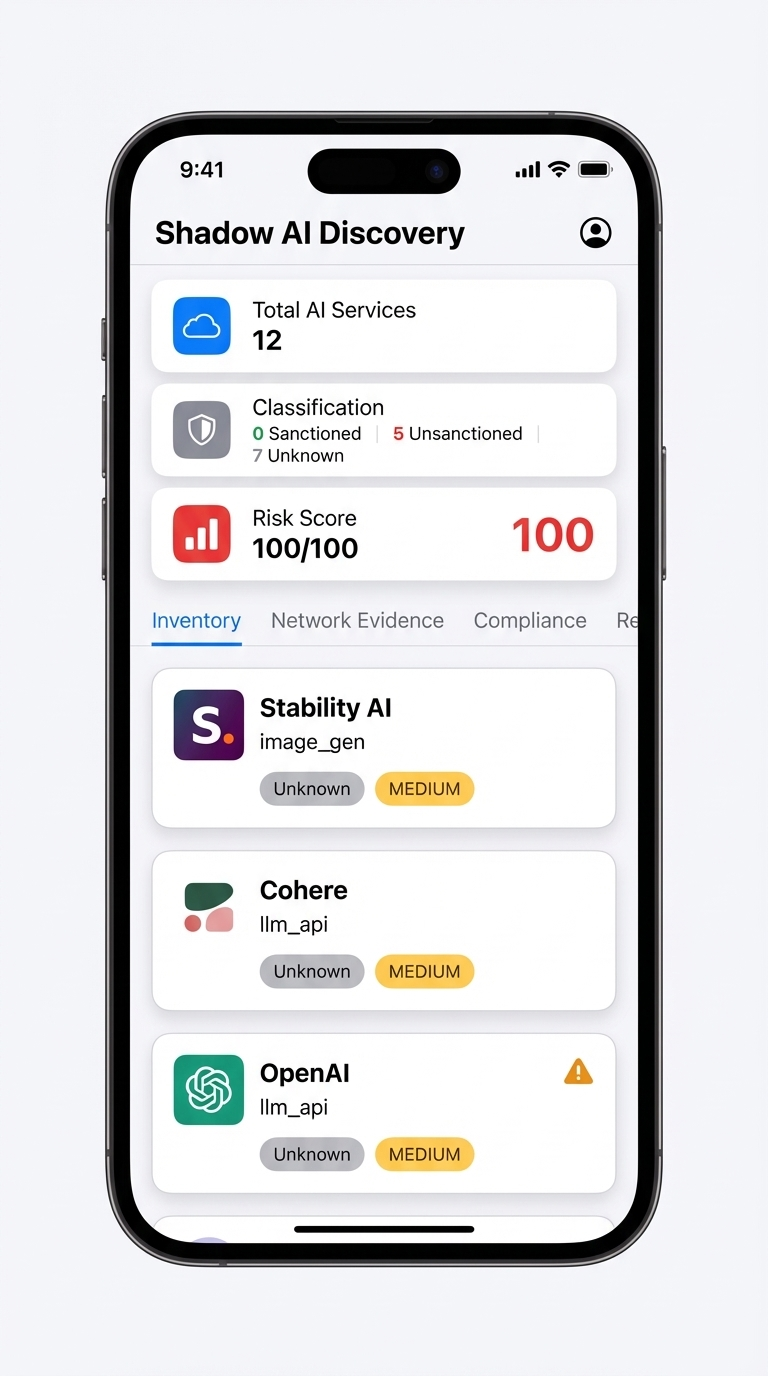
The Déjà Vu Nobody Wants to Acknowledge
Shadow IT was about unsanctioned SaaS apps — a marketing team spinning up a Trello board, or an engineer testing an AWS account on a personal credit card. Annoying, yes. But the blast radius was limited to data in that one tool.
Shadow AI is fundamentally different. When a developer pipes production customer data into an unauthorized LLM to "quickly build a demo," that data doesn't just sit in a SaaS database. It becomes part of training corpora, gets cached in inference pipelines, and may be retrievable by other users of the same model provider. The blast radius isn't a spreadsheet — it's your entire data estate.
And yet, most security teams are treating Shadow AI with the same playbook they used for Shadow IT a decade ago: send a survey, publish a policy, hope for the best. That didn't work then. It won't work now.
How We Got Here (Again)
The pattern is depressingly familiar. A new technology emerges that makes developers dramatically more productive. Procurement and security review processes take weeks. Developers, under pressure to ship, route around the bottleneck. Three months later, you discover you have a problem.
Here's what we're seeing in production environments right now:
- Hardcoded API keys to unauthorized model providers — OpenAI, Anthropic, Cohere, Mistral, and dozens of smaller providers. These keys are scattered across repositories, environment files, and CI/CD pipelines. Developers sign up with personal accounts, expense the API costs, and nobody in security is the wiser.
- Production data flowing to unvetted models — Customer PII, financial records, health data, and proprietary business logic being sent as prompt context to models with unknown data-retention policies. One engineering team we audited was sending full patient records to a model hosted in a jurisdiction with no GDPR equivalence.
- Zero audit trail — No logging of what data was sent, which model processed it, or what responses were returned. When the CISO asks "what AI models are we using?", nobody can answer with confidence. When regulators ask the same question under the EU AI Act, the silence becomes a compliance violation.
Why Traditional Discovery Methods Fall Short
The instinct is to reach for your existing security tools. Run a secrets scan. Check your CASB logs. Look at DNS queries. Each of these methods catches a slice of the problem, but none of them see the full picture.
Secrets scanning finds hardcoded API keys — but only when the key format matches a known pattern. Many AI providers use generic bearer tokens that don't trigger regex-based scanners. And secrets scanning tells you nothing about what data is being sent to those endpoints.
Network monitoring / CASBs can flag outbound connections to known AI provider domains. But they miss self-hosted models, proxied connections, and models accessed through aggregator platforms. They also can't tell you why the connection is being made or what code is driving it.
Developer surveys and policy attestations are the least effective method. Developers don't maliciously hide AI usage — they genuinely don't think of a quick API call as a "tool adoption" that requires security review.
The Two-Source Approach: Code + Network
Shadow AI lives at the intersection of two observable signals: what's in the code and what's on the wire. Individually, each signal is incomplete. Combined, they create a high-fidelity map of every AI integration in your environment.
Source 1: Static Code Analysis
We scan every repository for AI integration fingerprints — not just API keys, but SDK imports, model endpoint URLs, prompt templates, embedding calls, and RAG pipeline configurations. Our scanner recognizes patterns for 40+ AI providers and frameworks, including:
- Direct API calls to OpenAI, Anthropic, Google Vertex, Azure OpenAI, Cohere, Mistral, Replicate
- Framework-level integrations: LangChain, LlamaIndex, Semantic Kernel, Haystack, AutoGen
- Embedding and vector DB connections: Pinecone, Weaviate, Chroma, Qdrant, Milvus
- Self-hosted model deployments: Ollama, vLLM, TGI, LocalAI configurations
Source 2: Network Traffic Analysis
Simultaneously, we analyze outbound network traffic to identify connections to AI inference endpoints. This catches integrations that don't live in scanned repositories — scripts running on developer laptops, Jupyter notebooks, and CI/CD pipelines calling models directly.
The Correlation Engine
The real value comes from correlation. When we see an OpenAI SDK import in the code and outbound traffic to api.openai.com, we have high-confidence detection. When we see network traffic to an AI endpoint with no corresponding code in any scanned repository, we flag it as an untracked integration — possibly the most dangerous kind.
From Detection to Classification
Finding Shadow AI integrations is step one. The harder problem is deciding what to do about each one. Not every unauthorized AI usage is equally risky. A developer using Copilot for code completion is categorically different from one sending customer health records to a fine-tuning endpoint.
Every discovered integration enters a classification workflow:
- Unknown — Newly discovered. Automatically enriched with metadata: what data is being sent, which model provider, what data-retention policy the provider has, and whether the integration handles regulated data (PII, PHI, PCI).
- Under Review — Assigned to a security reviewer with full context. The reviewer sees the code, the data flow, the provider's security posture, and a risk score. No more "can you explain what this does?" back-and-forth with the developer.
- Sanctioned — Approved for use, with guardrails. Added to the organization's AI registry with conditions: approved data types, approved use cases, required monitoring.
- Unsanctioned — Blocked. The developer receives guidance on approved alternatives and a migration path. The integration is tracked until removal is verified.
This isn't about saying "no" to AI. It's about saying "yes, but with visibility." The fastest path to AI adoption is trust, and trust requires a registry.
Why This Matters Right Now: Regulation Is Coming
If the security argument doesn't move your leadership team, the compliance argument will. Two regulatory frameworks are converging to make Shadow AI an existential risk:
The EU AI Act
Article 6 of the EU AI Act requires organizations to maintain a registry of all AI systems, classify them by risk tier, and demonstrate ongoing monitoring and governance. You cannot comply with the AI Act if you don't know what AI systems you're running. Shadow AI isn't just a security problem — it's a regulatory blindspot that carries fines of up to €35 million or 7% of global turnover.
NIST AI Risk Management Framework (AI RMF)
The NIST AI RMF's "Govern" function explicitly requires organizations to inventory AI systems, assign accountability, and implement ongoing monitoring. While not (yet) legally binding in the US, it's rapidly becoming the de facto standard for AI governance — and federal procurement already references it. If you sell to the US government, NIST AI RMF compliance is table stakes.
Both frameworks share a common prerequisite: you must know what AI you're using before you can govern it. Discovery isn't a nice-to-have. It's the foundation of every compliance program.
Building an AI Registry That Stays Current
A one-time audit isn't enough. AI integrations are created and modified daily. Your registry must be continuously updated — not through manual entries and quarterly reviews, but through automated, always-on discovery.
The registry we build for each organization includes:
- Integration inventory — Every AI model, SDK, and endpoint in use, mapped to the repository and team that owns it.
- Data flow mapping — What data enters each AI system, what processing occurs, and where outputs are consumed.
- Risk classification — Automated risk scoring based on data sensitivity, model provider trust level, and regulatory applicability.
- Governance status — Sanctioned, Under Review, or Unsanctioned — with an audit trail of every status change.
- Drift alerts — Real-time notifications when new integrations appear or existing ones change scope.
The Bottom Line
Shadow AI is not a future problem. It's happening in your codebase right now. Every week you delay discovery, new integrations go live without review, new data flows bypass your governance controls, and your regulatory exposure grows.
The good news: unlike Shadow IT, which took a decade to address, we have the tooling and the playbook to tackle Shadow AI now. Two-source detection, automated classification, and a living registry turn an invisible problem into a managed one.
You don't need to ban AI. You need to see it.
Explore Shadow AI Discovery
See how two-source detection maps every AI integration in your environment — from hardcoded API keys to untracked network connections. Build a living AI registry that keeps pace with your developers.
Explore Shadow AI Discovery