Your SAST tool just flagged 2,347 findings in the latest scan. Your security team has three engineers. Even if each finding took five minutes to triage — and most take far longer — that's 195 person-hours of work. For one scan. Of one repository. And roughly 93% of those findings will turn out to be noise.
The Noise Factory
We've reached an absurd equilibrium in application security. Scanners are getting better at finding things, but not at determining whether those things matter. The result is a firehose of findings that overwhelms security teams and, more critically, destroys developer trust.
When developers learn that 9 out of 10 scanner findings are false positives, they stop looking at scanner output entirely. And that's rational behavior — if a system cries wolf 93% of the time, ignoring it is the economically efficient response. The problem is that the remaining 7% contains real, exploitable vulnerabilities that now go unaddressed.
The industry's answer has been to add more scanners (SAST, DAST, SCA, secrets, IaC), hoping that overlapping coverage will catch what individual tools miss. Instead, we've multiplied the noise. The average enterprise now runs 6–12 security scanning tools, each generating its own stream of context-free findings.
Why Scanners Get It Wrong
The fundamental problem is that traditional scanners arecontext-blind. They analyze code in isolation — a single file, a single function, a single line — without understanding the architectural context that determines whether a finding is exploitable.
Consider a SQL query built with string concatenation. A SAST scanner flags it as SQL injection (CWE-89). But is it actually exploitable? That depends on context the scanner doesn't have:
- Is the input user-controlled, or does it come from a trusted internal service?
- Is there a WAF or input validation layer upstream?
- Does the database user have permissions that would make injection impactful?
- Is this endpoint even reachable from an external attack surface?
Without this context, the scanner does the only responsible thing: it flags everything. And that's exactly why the false positive rate is 93%.
Architecture-Aware Review: A Different Starting Point
Architecture-aware code review inverts the traditional model. Instead of starting with pattern matches and hoping someone adds context later, it starts with context and uses patterns to validate concerns.
The approach requires three inputs that traditional scanners don't use:
- The threat model — What are the architectural threats, trust boundaries, and data flows? What assets need protection and from which threat actors?
- The application architecture — How do components connect? Where are the trust boundaries? Which components handle sensitive data? What security controls exist at each layer?
- The compliance requirements — Which regulatory frameworks apply? What specific controls are required? Which code paths implement those controls?
With this context, the review engine can answer the question that scanners can't: "Given our architecture, is this finding actually exploitable, and if so, what's the real-world impact?"
The Dual-Pass Approach
Architecture-aware review uses a two-pass methodology that combines speed with depth:
Pass 1: Fast Pattern Scan
The first pass runs high-speed pattern matching — similar to traditional SAST, but with a critical difference. Instead of reporting every match, it creates a candidate list. Each candidate is tagged with the CWE, the code location, and a preliminary severity. This pass completes in seconds, even on large codebases.
Pass 2: Contextual Deep Review
The second pass is where architecture awareness transforms the results. Each candidate from Pass 1 is evaluated against:
- Data flow context — Is the input user-controlled? Does it cross a trust boundary?
- Architectural position — Is this component internet-facing, internal-only, or behind a VPN?
- Existing controls — Are there upstream validation, WAF rules, or sanitization functions that mitigate this finding?
- Threat model relevance — Does this finding map to a threat that's been identified in the architecture review?
- Compliance impact — Does this finding violate a specific control requirement?
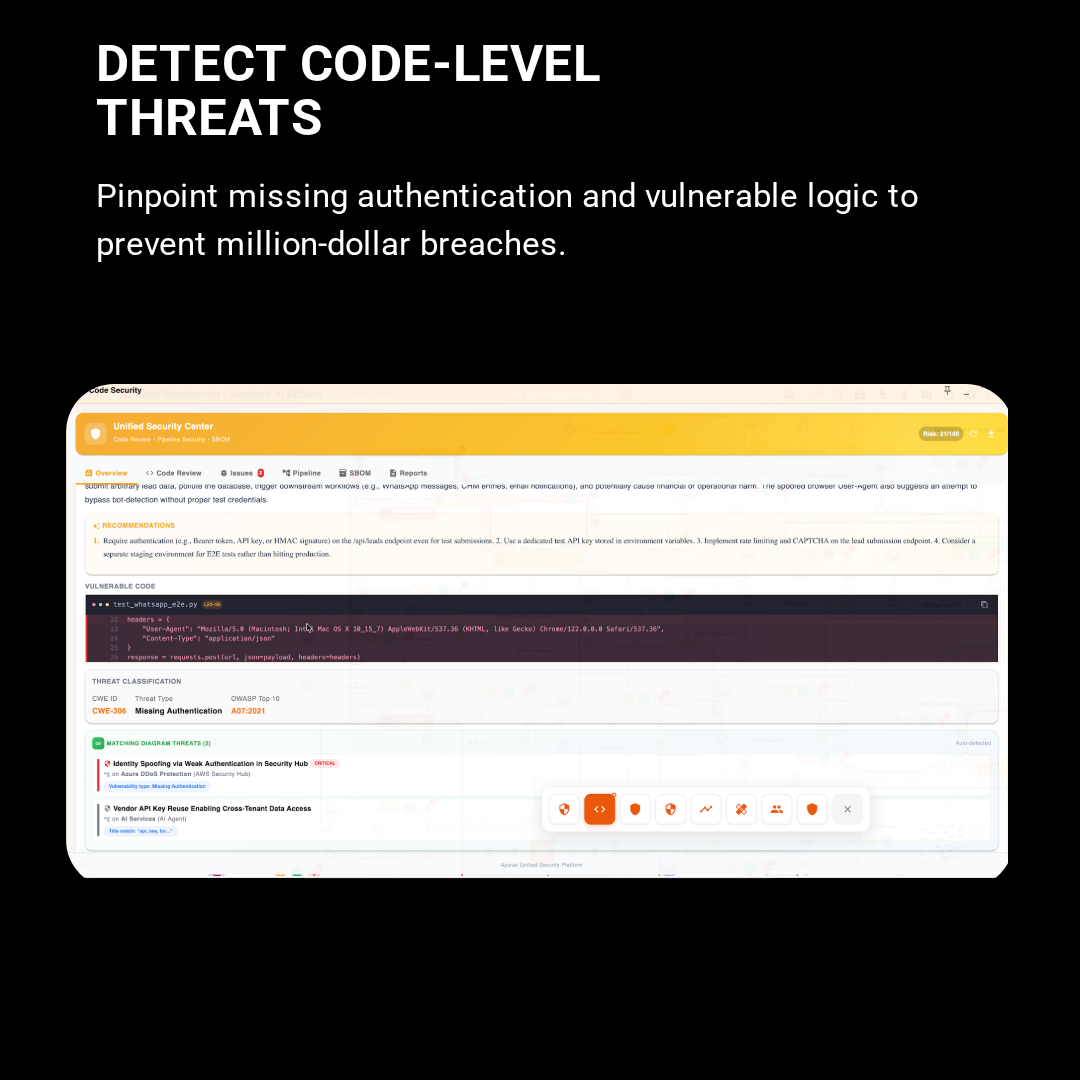
Candidates that survive Pass 2 are genuine findings with full context: the vulnerability, the attack path, the business impact, and the compliance implications. Candidates that don't survive are suppressed with a documented reason — not silently dropped, but explicitly dismissed with an audit trail.
A Real Example: The Hardcoded Credential
Let's walk through a concrete example. Your secrets scanner flags a hardcoded string that looks like an API key in a test file:
// test/integration/payment.test.ts
const STRIPE_KEY = "sk_test_4eC39HqLyjWDarjtT1zdp7dc";
A traditional scanner flags this as "High — Hardcoded Secret (CWE-798)" and moves on. Now the developer has to determine: is this a real Stripe secret key, or is it a well-known test key?
Architecture-aware review handles this automatically:
- Pattern match: The
sk_test_prefix is identified as a Stripe test-mode key — not a live key. - File context: The file is in a
test/directory, which is excluded from production builds. - Architectural context: This test file communicates with Stripe's sandbox environment, which contains no real payment data.
- Decision: Suppressed as informational. Reason: "Test-mode credential in test directory, no production data exposure."
Now contrast that with the same pattern in a production file:
// src/services/payment.ts
const STRIPE_KEY = "sk_live_51Hb3azLkjKJH28s...";
Architecture-aware review escalates this as Critical: live credential, production code path, handles financial data, violates PCI DSS Requirement 2.1.a. The finding includes the specific threat (credential theft leading to unauthorized payment processing), the attack path (source code access → API key extraction → financial fraud), and the compliance violation.
Same CWE. Same scanner pattern. Completely different risk. That's the difference context makes.
Why Developers Actually Fix Things When Context Is Clear
Here's a finding that gets ignored:
"High: CWE-89 SQL Injection in UserRepository.java:142"
And here's one that gets fixed in the same sprint:
"Critical: SQL injection in the user search endpoint allows unauthenticated attackers to extract the full users table, including password hashes. This endpoint is internet-facing (no WAF), handles PII subject to GDPR Article 32, and maps to Threat T-4 in the architecture review. Suggested fix: replace string concatenation with parameterized query using the existing QueryBuilder utility at src/db/QueryBuilder.java."
The second finding takes the same amount of time to generate — the machine is doing the contextual analysis, not the human. But it communicates why this matters, what the real-world impact is, and how to fix it. Developers respond to context, not severity labels.
The Numbers After Switching
Organizations that move from traditional scanning to architecture-aware review consistently see dramatic improvements across four metrics:
- False positives drop from 60–80% to under 15% — The remaining 15% are edge cases where architectural context is ambiguous, not failures of the tool.
- Mean Time to Remediate (MTTR) drops 40–60% — Developers fix things faster when they understand the attack path and have a suggested fix. No more "what does this even mean?" back- and-forth with security.
- Security engineering capacity recovers 50–70% — Time previously spent triaging false positives is redirected to architecture reviews, threat modeling, and proactive security work.
- Developer satisfaction with security tooling increases measurably — NPS scores for security tools go from deeply negative to positive. Developers start requesting scans instead of dreading them.
Integrating Into Your Existing Workflow
Architecture-aware review doesn't require ripping out your existing tools. It layers on top of them, using their output as input to the contextual analysis engine. Your SAST tool becomes the fast-scan first pass. The architecture-aware layer becomes the intelligent second pass that separates signal from noise.
Integration points include:
- PR/MR comments — Findings appear as inline code review comments with full context.
- IDE plugins — Real-time feedback as developers write code, with architectural context.
- CI/CD gates — Only genuine findings block the pipeline. False positives never break a build.
- SIEM/SOAR — High-confidence findings feed directly into security operations workflows.
The Uncomfortable Truth
The security industry has optimized for detection volume — finding as many potential issues as possible — because volume is easy to measure and easy to sell. "Our scanner finds 10x more vulnerabilities" sounds impressive in a vendor pitch.
But detection volume is a vanity metric. The metric that matters isexploitable findings remediated per sprint. And on that metric, a system that surfaces 50 real findings beats one that surfaces 2,000 findings of which 1,860 are noise.
Every false positive has a cost: developer time wasted, security credibility eroded, and real vulnerabilities buried in noise. The question isn't whether you can afford architecture-aware review. It's whether you can afford to keep crying wolf.
See Architecture-Aware Review in Action
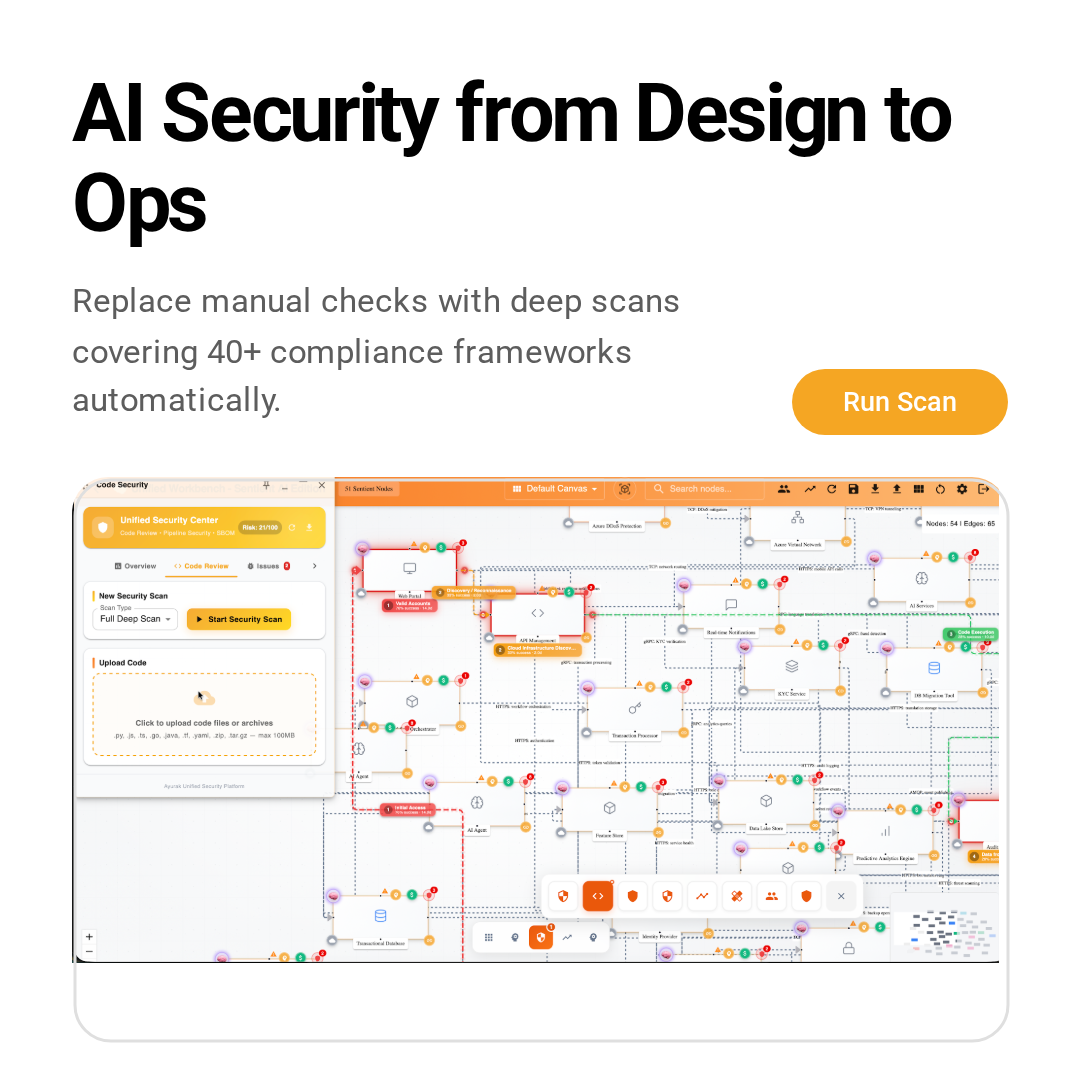
Run a scan on your own codebase and see the difference context makes. Compare raw scanner output with architecture-aware findings — side by side, same code, dramatically different signal-to-noise ratio.
See Architecture-Aware Review in Action