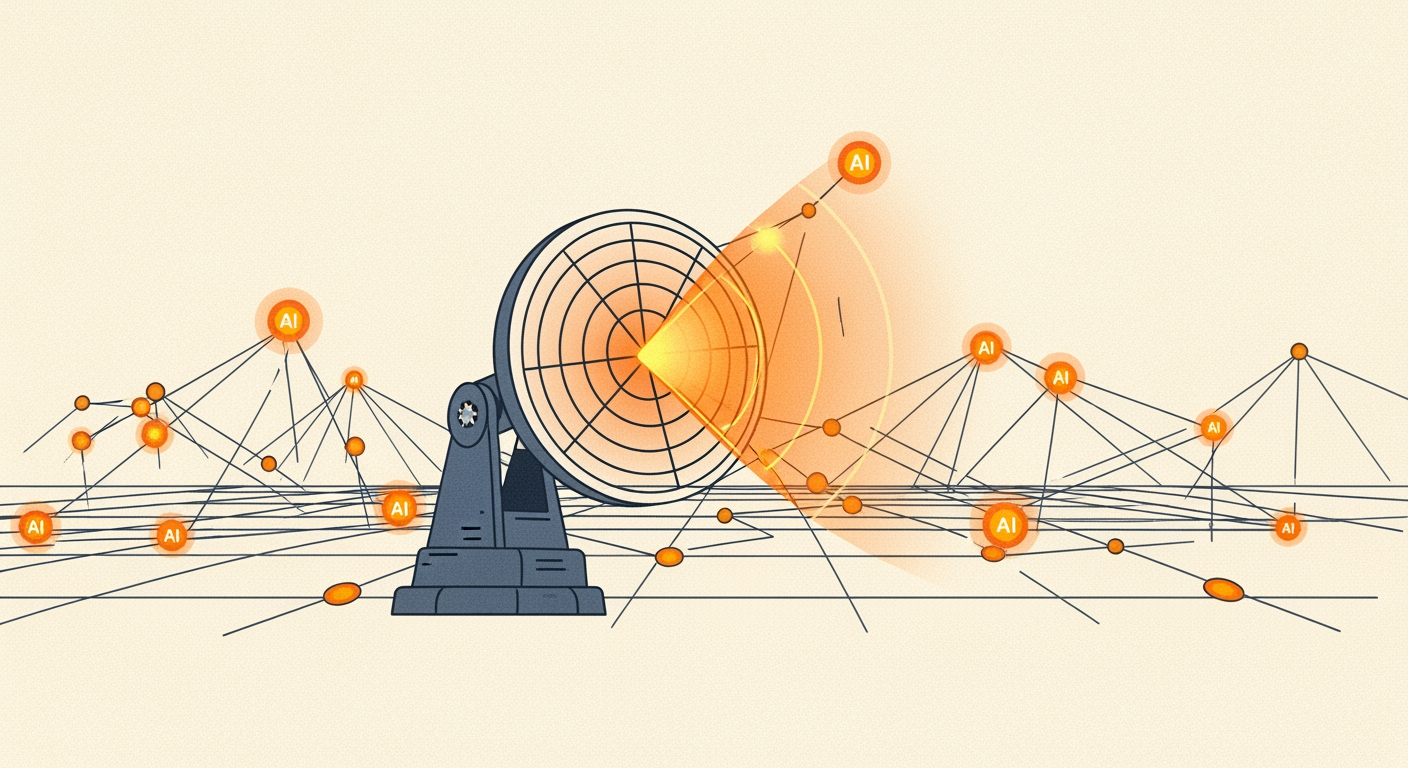
The hard part of shadow AI isn't writing the policy. It's producing the inventory the policy applies to. Aribot's approach is the same one the cloud era proved out: you cannot govern what you cannot see, so the first job is to make every AI touchpoint visible — then classify it, then put it under control.
Watch the full Shadow AI Detection walkthrough
More on the Ayurak AI channel.
Step 1 — Discover where AI actually lives
Aribot looks where AI use actually shows up rather than where a catalogue says it should. It reads your architecture — diagrams, infrastructure definitions, the components that make up your system — and your code, and surfaces the places where an AI model, an LLM API, or an AI dependency is in play. That includes the uncomfortable ones: a key wired into a service, a model invoked deep in a pipeline, an integration nobody added to the register.
Architecture-level, not just endpoint-level
Because Aribot reasons about your system as a connected topology, it can see an AI component in context — which services call it, what data reaches it, and where its output flows next. That is the difference between “something talked to an AI domain” and “this service sends customer records to this model, and the result lands here.”
Step 2 — Classify the risk
An inventory of equal-weighted entries is just a longer to-do list. Aribot classifies each AI touchpoint by what actually makes it risky: the sensitivity of the data flowing in, the exposure of the component, and the relevant threat patterns. It maps findings to the recognised references that auditors and engineers already use — the OWASP Top 10 for LLM Applications, MITRE ATLAS for adversarial ML, and the control expectations behind frameworks like the NIST AI RMF and the EU AI Act — so a finding arrives with context, not just a flag.
Find AI use across architecture and code — sanctioned and shadow alike.
Rank by data sensitivity, exposure, and mapped LLM/ATLAS threat patterns.
Turn the inventory into policy, evidence, and continuous monitoring.
Step 3 — Govern continuously
A one-time scan ages the moment a developer adds the next integration. The inventory has to be living. Aribot re-evaluates as the architecture and code change, so a newly introduced AI dependency shows up as a new entry rather than a surprise in next year's audit. Governance stops being a quarterly snapshot and becomes a continuous state — which is exactly the posture the emerging AI regulations are written to expect.
A list of AI tools tells you what to worry about. A map of AI tools in your architecture tells you which ones to worry about first — the ones touching regulated data on an exposed path. That prioritisation is the difference between a report that gets actioned and one that gets archived.
From blind spot to control surface
The outcome is a shift in posture. Instead of discovering shadow AI through an incident, you hold a current inventory you can reason about: what AI is in use, what data it sees, how exposed it is, and which frameworks it touches. That inventory is what lets you answer the board's governance question and the regulator's evidence request with the same artefact.
New to the problem? Start with why your existing CASB, DLP and SSO logs can't see shadow AI in the first place.
Shadow AI: the unseen risk