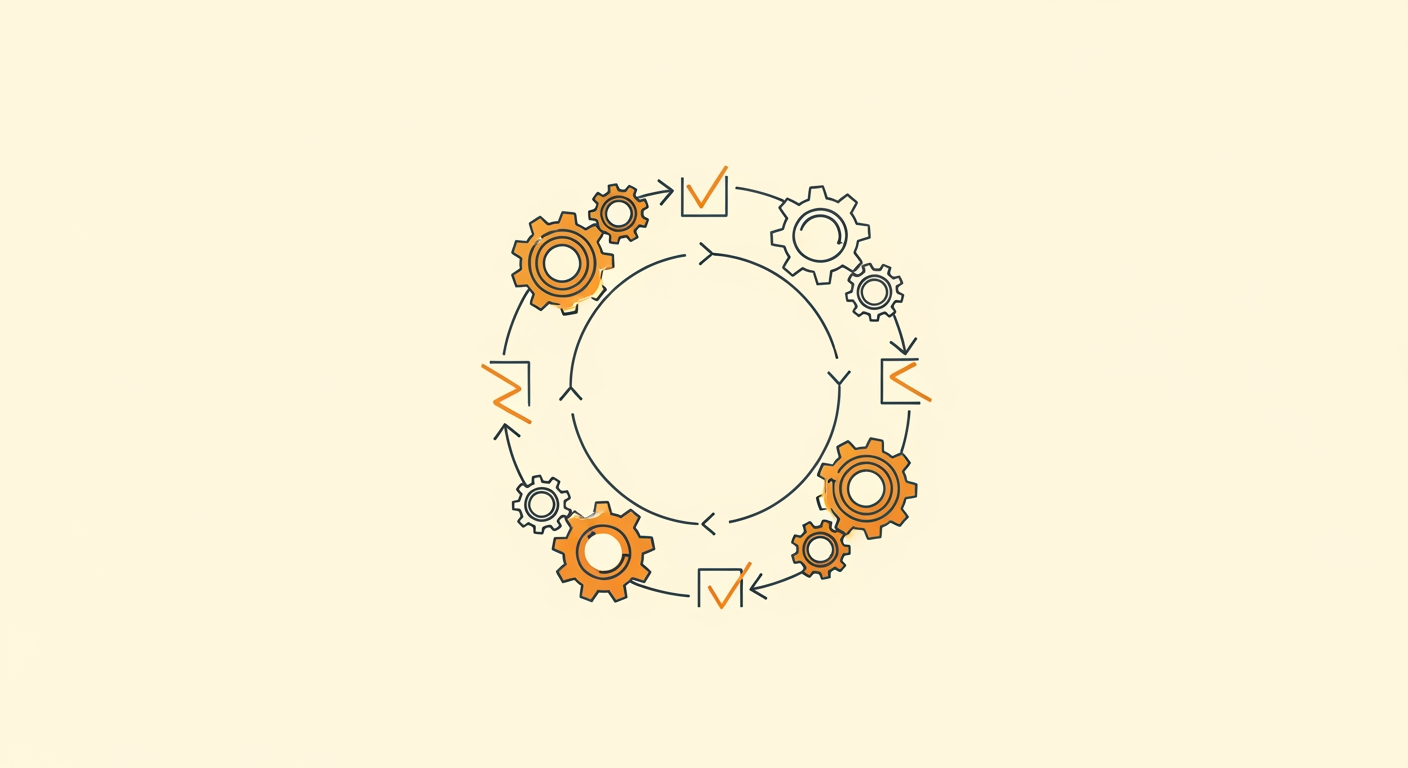
“Self-healing” sounds like a system that quietly rewrites itself while you sleep. That version should terrify any engineer. The version worth building is the opposite of mysterious: a small loop, the same five phases every time, that never mutates anything without first capturing how to undo it — and never stays silent about what it did.
The contract, in one paragraph
Every heal runs the same five phases. Detect by probing the real upstream dependency, not a cached status. Classifythe failure into a known class. Remediate behind a captured rollback anchor. Verify by re-probing the same dependency with the new state. Escalate with a full diff, on success and on failure alike. If verification fails, roll back to the anchor and leave the system broken-but-known rather than half-fixed.
Probe the real dependency. Drift = running value vs source of truth.
Name the failure: expired token, config drift, quota burn, stale cache.
Capture a rollback anchor, then mutate the smallest possible thing.
Re-probe upstream with the new value. Still broken? Roll back.
Email the diff — always. Silent auto-mutation hides root causes.
Phase 1 — Detect against reality
Detection is where most monitoring goes wrong, so the contract is strict: probe the actual upstream. To check a database credential, open a connection and run a query — don't read the config and assume. To check a mail provider key, call the provider's scopes endpoint. Drift is defined as a measurable disagreement between the value the running process holds and the value in the source of truth. If the probe passes, there is nothing to heal and the loop ends.
Phase 2 — Classify before you touch anything
Not every failure should be auto-healed, and the ones that should each need a different repair. Classification sorts the signal into a known class — credential drift, an expired token, a quota burn, a stale front-end bundle — and a failure that doesn't match a known, allow-listed class is escalated to a human untouched. The engine never improvises on a failure it doesn't recognise.
Phase 3 — Remediate behind a rollback anchor
This is the phase people fear, so it carries the most guardrails. Before any mutation, the current value is read and logged — that captured anchor is the entire safety story. Then the engine changes the smallest possible thing: patch the one secret, restart the affected deployments, trip the one circuit breaker. The blast radius of a heal should be a scalpel, never a carpet bomb.
- A kill switch per domain, defaulted off — opting in is the only path to mutation.
- A per-target allow-list. Some values (a signing secret that would log everyone out) are explicitly excluded.
- Capture-before-mutate: the rollback path is always one API call away.
- A rate limit per run. If a whole class of secrets is mass-drifting, escalate to a human rather than mutating everything.
Phase 4 — Verify, or roll back
A repair that isn't verified is just a hopeful guess. After remediation the engine re-runs the same real probe from phase one. If it passes, the heal stands. If it still fails — the source of truth held a bad value too, a typo, a half-finished rotation upstream — the engine patches back to the captured anchor and restarts. The system returns to broken-but-known. That is the single most important property of the whole design: it will never leave you in a novel, half-applied state that nobody has ever debugged before.
Phase 5 — Escalate, always
Every action sends a notification — success and failure both. This feels redundant until you live with a system that mutates silently. Silent auto-repair masks the underlying bug: the credential keeps drifting, the quota keeps burning, and because the symptom keeps vanishing, nobody fixes the cause. Surfacing every heal turns the repair log into a leading indicator. If drift is happening more often than expected, you find out from the volume of heal emails long before it becomes an incident.
The same contract handles security drift
Once the loop exists for configuration, it extends naturally to security posture. A public endpoint that shipped without a rate limit: detect the traffic spike and the missing throttle, patch the ingress at the edge in seconds, then open a pull request adding the throttle decorator in source so the next deploy can't undo it. A storage bucket exposed to the public internet: revoke the binding, lock down access, and replay the access logs for forensics. The infra heal is immediate; the code fix follows as a reviewable change. Heal the symptom now, fix the root cause in the open.
Why two minutes is the whole point
The two-minute ceiling isn't a performance brag — it's a safety boundary. A repair that hasn't demonstrably improved the system inside that window is treated as a failed repair and reverted. That single rule is what lets you trust an automated mutation in production: the worst case is bounded. You either end better than you started, or exactly where you started, with a loud email either way. There is no third outcome.
This is the engineering view. For the business case — what drift costs, and why speed beats patching — read the executive brief companion.
Sources & further reading
- Techstrong — From AIOps hype to reality (2026)
- Komodor — Autonomous self-healing for cloud-native ops
- Elarafy — Autonomous infrastructure & self-healing in 2026
- Groundcover — Secret rotation: how it works, challenges, best practices
- Safeguard — How to rotate leaked secrets with automation (2026)
- CMU SEI — Netflix and the Chaos Monkey